
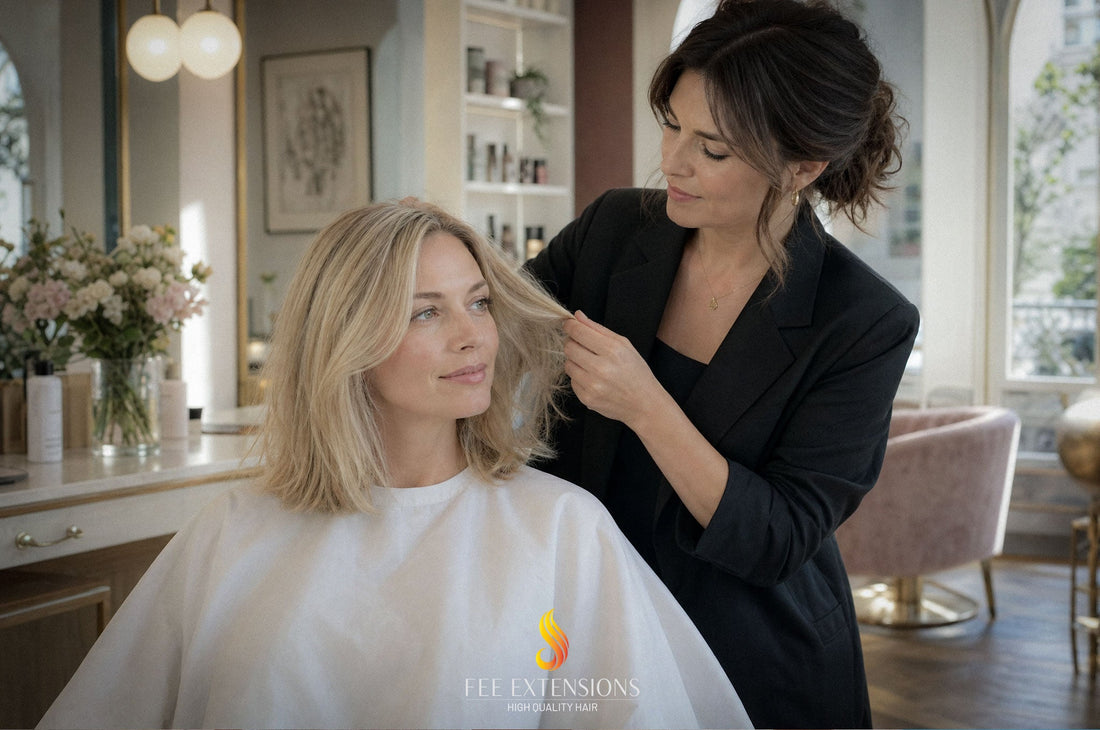
Hair extensions for fine or thin hair: which method is suitable?
Share
Hair extensions may be possible with fine hair, but only if the natural hair has sufficient strength and coverage. The safest choice is not automatically the lightest or newest method: quantity, attachment, and distribution must be tailored personally.
Fine hair is not the same as thinning hair
Fine hair refers to the diameter of each individual hair. Someone can have a lot of fine hairs and still have a full head of hair. Thin hair can mean that the overall density is lower. Active hair loss, breakage, or bald spots require a different assessment than naturally fine but healthy hair.
In the case of sudden or persistent hair loss, it is advisable to seek professional or medical advice first. Extensions do not solve the cause of hair loss and are not suitable in every situation.
What does an extension specialist look for?
- the density and elasticity of the natural hair;
- the condition of the scalp and lengths;
- sufficient coverage above and around the attachments;
- the strength of the contours and sides;
- the desired length and quantity;
- the daily styling and maintenance routine.
A good result should not only look beautiful on the day of application. It must also remain comfortable as the natural hair grows.
Keratin extensions for fine hair
Keratin U-Tips consist of individual strands. This allows a specialist to precisely distribute the size, quantity, and placement. This can be interesting for fine hair when subtle volume is desired around the sides or contours.
The sections of natural hair must always be strong enough to support the weight of each strand. Very small bondings are not automatically safer if there is too little natural hair attached to them.
Genius Weft for fine hair
A Genius Weft has a thin, flexible top and can lay flat. With fine hair, the combination of the row, quantity, and attachment is particularly important. A normal Genius Weft can sometimes be a better fit than a Double Genius Weft, because more density also means more weight per track.
There must be enough hair above the row to cover the attachment. With a very transparent crown or high hairline, a different distribution may be required.
What is the least damaging method?
There is no single method that is the least damaging for everyone. Damage occurs more often due to a poor balance between weight and strength, attachment that is too tight, delayed maintenance, or unprofessional removal. Therefore, the technique must be adapted to the hair, not the other way around.
How much hair do you need?
For volume alone, you usually need less hair than for a full extension. With fine hair, volume is often built up carefully. A large jump in length requires more mass to blend naturally and is therefore not always the best first choice.
Read our guide how many hair extensions do you need? and compare Keratin extensions and Genius Weft.
When are extensions discouraged?
- in case of active or unexplained hair loss;
- in case of an irritated or damaged scalp;
- when the hair is breaking severely;
- if there is insufficient coverage;
- when maintenance is not feasible;
- if the desired length or quantity would be too heavy.
Frequently Asked Questions
Are extensions visible in fine hair?
With correct placement and sufficient coverage, they do not have to be visible. However, wind, high ponytails, and a transparent crown should be discussed beforehand.
Is Double Genius Weft suitable for fine hair?
Not automatically. A double track contains more hair and therefore more weight. A specialist must assess whether the carrying capacity is sufficient.
Can extensions hide hair loss?
Extensions can add volume, but they do not treat hair loss. In the case of active hair loss, an expert assessment is required first.
Can I start with just volume?
Yes, when the hair is suitable, a subtle thickening can be a responsible first step. Less is often more natural and comfortable.