
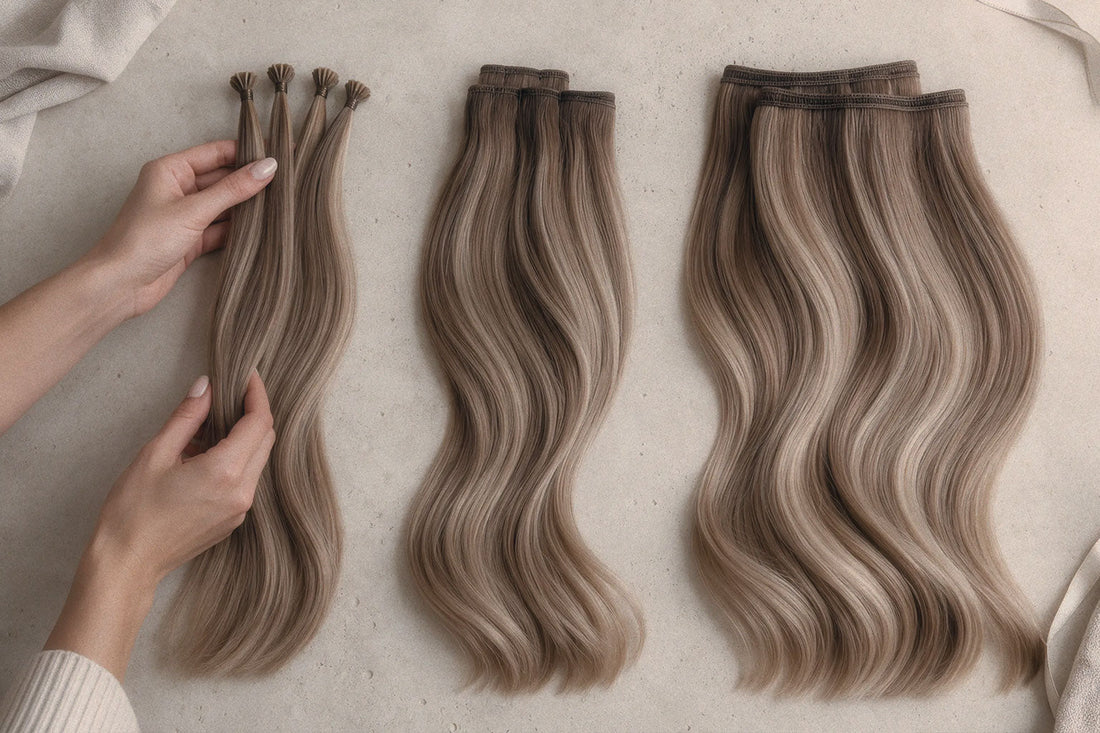
How many hair extensions do you need for volume or length?
“How many extensions do I need?” is one of the most frequently asked questions. Yet there is no fixed number that works for everyone. The right amount depends on your goal, the thickness and cut of your natural hair, and the length you want. Too little hair can leave a visible transition; too much can feel heavy.
Volume and length are not the same
Want to make fine or thin hair look fuller without adding much length? You will usually need less extension hair. A full lengthening must add not only volume but also enough density below your current hairline.
These factors determine the amount
1. The thickness of your natural hair
The thicker your natural hair is, the more extension hair may be needed to carry its natural fullness through to the ends. Fine hair often needs less, but its weight must be distributed especially carefully.
2. Your current length
A modest lengthening is easier to blend than a big jump to 50 cm. Short hair generally needs more hair and more precise placement to soften the transition.
3. Your haircut
Blunt-cut ends create a clear horizontal line. Enough density is needed below it. Layers can soften the transition, but should only be cut deliberately by a professional.
4. The result you want
A subtle, natural thickening is different from a full, glamorous look. Do not use someone else’s result as your only guide.
5. The method you choose
With U-Tips, a stylist often calculates by strand or weight. With a Genius Weft, they consider total weight, weft width and the number of safe rows. Do not compare U-Tip counts directly with the number of weft rows.
Why a chart is never enough on its own
Online guidance can give you a starting point, but it cannot assess how much weight your hair can support or its condition. Two people with shoulder-length hair can have very different density. A specialist also checks the temples, sides, crown and natural fall.
Normal or Double Genius Weft?
A Double Genius Weft contains more hair in each weft and is intended for a fuller result. That does not automatically make it a better choice for everyone. With fine hair, a normal weft may offer more flexibility when distributing weight. With thicker hair, a Double version may help achieve the desired density with fewer rows.
How to avoid a visible transition
- Choose enough hair to suit the thickness of your own ends.
- Match the colour to both the mid-lengths and ends.
- Have a professional distribute the extensions.
- Finish the application with a blending cut.
- Ask the stylist to check weight and tension.
Our honest advice
Do not order based only on a universal number of grams or strands. Send clear photos or ask the professional applying your extensions to assess your natural hair. They can create the safest, most suitable plan.
Explore our rangeKeratin U-Tips and 50 cm Genius Wefts.


Frequently asked questions
Is more hair always better?
No. The amount should suit your natural hair. A natural blend and safe weight distribution matter more than maximum volume.
Can I add more hair later?
That depends on the method, application and condition of your hair. Always discuss changes with your specialist.